 Pinpoint
Pinpoint
Pinpoint
Master the art of spotting scoring opportunities, setup patterns, and tactical formations in Pinpoint
Pattern recognition is the single most important skill separating novice Pinpoint players from experts. While beginners see individual pins and colors, advanced players perceive entire formations, potential chains, and multi-move sequences in milliseconds. This cognitive shift transforms gameplay from reactive pin placement to proactive pattern construction. The ability to scan the board and instantly identify all scoring opportunities, defensive threats, and setup potential is what allows strong players to make optimal decisions under time pressure.
Human pattern recognition operates through trained perception. Chess masters don't calculate every possible move—they recognize board positions from thousands of games stored in memory. Similarly, Pinpoint experts develop mental templates for scoring patterns, allowing instant identification of squares, crosses, line extensions, and reversal setups. This guide teaches you to build these mental templates systematically, transforming board chaos into structured tactical opportunities.
Lines form the foundation of all Pinpoint patterns. A line consists of adjacent pins in the same color, either horizontally or vertically arranged. Lines score progressive points: 2-lines (2 points), 3-lines (3 points), 4-lines (4 points), 5-lines (5 points), and the coveted 6-lines (enabling reversals worth 10 points). Mastering line recognition begins with training your eye to track color continuity across the board's grid structure.
The critical skill isn't just seeing existing lines—it's identifying extension potential. A 3-line with open space at both ends represents two scoring opportunities: extending from either direction scores 4 points. Smart players position these extendable lines near section centers or crossing points with perpendicular 3-lines, creating dual-threat formations where opponents cannot block both opportunities simultaneously.
Squares represent Pinpoint's most efficient point-per-space ratio. A 2x2 square formation of same-color pins scores 4 points, or 8 points when positioned on section centers marked by blue grid intersections. The geometric elegance of squares makes them easier to construct than long lines but harder to spot for beginners because they require diagonal spatial reasoning rather than simple linear tracking.
Square recognition training begins with identifying incomplete squares—three pins of matching color arranged in an L-shape or three-quarter formation. These incomplete squares represent immediate scoring opportunities: place the fourth pin to complete the square. Strong players classify incomplete squares by urgency: a three-quarter square near a section center demands priority, while corner squares yield lower value.
Practice this daily: Pause at move 30 of any game. Systematically scan each section for incomplete squares (3 matching pins in L or C formation). Count them by color. Target: identify all incomplete squares within 15 seconds. Expert players complete this scan in under 5 seconds.
Crosses form when horizontal and vertical lines of the same color intersect at a shared pin. A standard cross (one horizontal 3-line intersecting one vertical 3-line) scores 6 points. Extended crosses grow more valuable: intersecting 4-lines score 8 points, while intersecting 5-lines yield 10 points. The maximum cross—intersecting 6-lines before reversal—scores 12 points. Crosses positioned on section centers double their value, making center-point crosses the highest-value single-move plays in Pinpoint.
Cross recognition requires three-dimensional thinking: you're tracking not just horizontal and vertical lines, but their intersection points. Train yourself to examine every 3-line for crossing opportunities. Does a red vertical 3-line pass through cells where a red horizontal 3-line could form? If so, that intersection point becomes a premium placement target. Learn more about the mathematical foundations of cross scoring optimization to deepen your understanding.
While Pinpoint scoring emphasizes orthogonal patterns (horizontal and vertical), diagonal relationships significantly impact pattern formation. Diagonal pin arrangements create visual confusion that strong players exploit. A diagonal line of matching colors looks threatening but scores nothing directly—yet these diagonal formations often disguise incomplete squares or position pins optimally for future cross development.
Diagonal recognition assists square identification. Squares have two diagonal axes through their center. When you spot two same-color pins arranged diagonally (e.g., top-left and bottom-right of a potential square), check the other diagonal axis. If those two positions also match in color, you've found a square. This diagonal-first scanning method often reveals squares faster than edge-based recognition, especially in densely populated board sections.
The 6-line reversal represents Pinpoint's most dramatic pattern transformation. When you complete a 6-line (horizontal or vertical), all pins in that line turn black and you score 10 points. But the secondary effects often matter more than the immediate score: opponent patterns vanish as their colored pins become black, your own patterns might disappear, and new scoring opportunities emerge from the transformed board state. Recognizing reversal setups—and defending against them—is mandatory for competitive play.
Reversal setup identification focuses on 4-lines and 5-lines with extension potential. A 5-line with one open end represents an immediate reversal threat. A 4-line with open ends at both sides represents a loaded gun—either end completion creates a 5-line, setting up reversal next turn. Practice scanning boards specifically for these reversal precursors: how many 4-lines exist with double-ended extensions? How many 5-lines have open ends?
Defensive reversal recognition is equally critical. When you spot an opponent 4-line building toward 5-line status, calculate the reversal impact: which of your patterns would be destroyed? If a reversal would erase your carefully constructed 8-point center square, you must block immediately regardless of scoring opportunities that turn. Visit our comprehensive game guide for detailed reversal mechanics and defensive strategies.
Not all scoring patterns offer equal value. Skilled players operate with an intuitive priority hierarchy that guides move selection when multiple opportunities exist simultaneously. The hierarchy considers immediate point value, board position value (center vs. edge), setup potential, and defensive necessity.
The general priority order: (1) Block critical opponent threats (5-line reversals, high-value center patterns), (2) Complete center-point crosses and squares (doubled value), (3) Execute your own reversal setups, (4) Build extendable 3-lines and 4-lines, (5) Complete standard scoring patterns (regular lines, squares, crosses), (6) Place positioning pins that don't score immediately but enable future patterns. Game context adjusts priorities—in close endgames, immediate points matter more than setup potential.
Even experienced players fall into recurring pattern recognition errors. The most common trap is tunnel vision: focusing intensely on constructing one pattern while missing superior opportunities elsewhere or failing to see opponent threats developing. Combat tunnel vision through disciplined full-board scanning. Before committing to any move, complete a systematic board sweep: check all four sections for incomplete squares, scan for dangerous opponent lines, identify all your own extendable formations.
The "almost pattern" trap seduces intermediate players. You see two pins of matching color close together and convince yourself this represents meaningful pattern potential, even when actual scoring completion requires three or four more perfect placements. Realistic pattern evaluation separates wishful thinking from genuine opportunities. A legitimate setup pattern requires at most two moves to completion with high probability you'll hold the necessary colors.
Color confirmation errors occur under time pressure. You identify a pattern shape correctly but misread the colors: what looked like a red incomplete square turns out to be red-blue-red-yellow—no pattern at all. Train yourself to verbalize colors mentally: "red-red-red-blank equals incomplete square" rather than just seeing shape. The extra cognitive step prevents color blindness errors.
Understanding scoring patterns becomes clearer with visual reference materials. The official Pinpoint scoring patterns diagram illustrates all fundamental formations: lines from 2-pins through 6-pins, both horizontal and vertical orientations; complete squares in 2x2 formations with section center bonus indicators; crosses showing perpendicular line intersections at various line lengths; and reversal transformations depicting before-and-after board states when 6-lines trigger the black conversion.
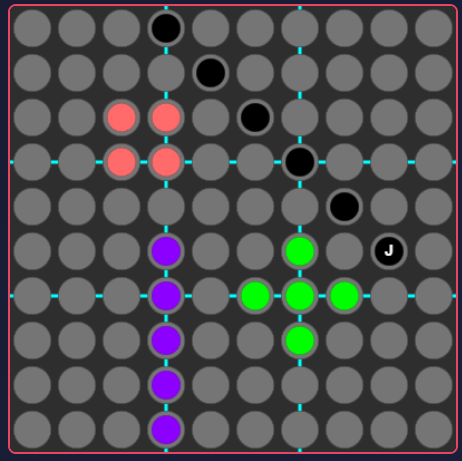
Complete pattern reference showing scoring formations and point values
Study this visual reference alongside actual gameplay. Print or display the pattern diagram while playing practice games against AI opponents. Each time you identify a scoring opportunity on the live board, verify your recognition against the reference diagram: does your identified pattern match the illustrated formation exactly? This reinforcement training accelerates pattern internalization, transitioning knowledge from conscious recognition to automatic perception. Within 20-30 games of deliberate practice with reference material, most players achieve fluent pattern recognition at intermediate skill level.
Deliberate practice accelerates pattern recognition development far beyond casual gameplay. Exercise One: Pattern Counting Sprint. Pause any game at move 40. Set a 30-second timer. Count all incomplete squares (exactly three pins in position), all extendable 3-lines, and all potential crosses. Record your count. Review carefully and compare against actual count. Track accuracy percentage over 20 sessions—target 95% accuracy within 30 seconds.
Exercise Two: Color Isolation Scanning. Select one color (e.g., red). Scan the entire board and mentally note every red pin's position. Now close your eyes and visualize the board with only red pins visible, all others blank. Can you reconstruct the red pattern formation from memory? Open your eyes and verify. Repeat for all six colors. This trains color-specific pattern tracking essential for managing multi-color strategies.
Exercise Three: Reversal Threat Analysis. Review recorded games or paused board states. Identify every 4-line and 5-line. For each, determine: (1) Can it extend to reversal? (2) How many moves until completion? (3) What patterns would be destroyed by this reversal? This analytical exercise develops strategic foresight. Practice this analysis on 10 different board positions weekly.
Pattern recognition alone doesn't guarantee victory—you must integrate recognition skills into coherent strategic decision-making. Think of pattern recognition as data collection and strategy as data processing. Your eyes gather information about board opportunities; your strategic thinking evaluates those opportunities against game context, opponent tendencies, and win conditions.
Adaptive pattern pursuit separates strong pattern recognizers from strong players. Recognizing a perfect center-point cross opportunity matters little if pursuing it exposes you to opponent reversal threats that cost 20 points. Integrate threat assessment into pattern recognition automatically: when you spot a scoring opportunity, immediately scan for opponent counter-patterns enabled by your move.
The ultimate skill is predictive pattern recognition: seeing patterns that don't yet exist but will emerge from current board trajectories. Expert players visualize board states two, three, or four moves ahead, recognizing future pattern potential in present pin arrangements. Developing this temporal pattern recognition requires extensive experience, but even intermediate players can practice one-move-ahead visualization, building the neural pathways that eventually support deeper prediction.
Pattern mastery develops through consistent practice and strategic integration: